What Are Oven Calibration Services?
Oven Calibration Services involve checking an oven’s actual operating temperature against its selected temperature and determining whether an adjustment or repair is necessary. The process helps identify temperature inaccuracies that can affect cooking results, food preparation, and appliance performance.
An oven set to a particular temperature does not necessarily maintain that exact temperature continuously. Heating elements switch on and off as the appliance regulates heat, and the temperature inside the cooking cavity can fluctuate during operation. The important question is whether the oven’s temperature behaviour remains within the manufacturer’s specified operating tolerance.
For homeowners, restaurants, hotels, and commercial kitchens in Dubai, professional oven calibration can help identify temperature-related problems before they interfere with regular cooking operations. The inspection may involve checking the thermostat, temperature sensor, electronic controls, heating system, and actual cavity temperature.
Oven calibration is not always a matter of changing a temperature setting. If a sensor, thermostat, wiring connection, or heating component is defective, the underlying fault may need to be repaired before accurate temperature control can be restored.
Understanding Oven Temperature Calibration
Oven Temperature Calibration is the process of comparing the oven’s indicated temperature with an independently measured temperature under controlled operating conditions.
For example, an oven may be programmed to operate at 180°C, but an appropriate temperature measurement may indicate that its actual temperature is consistently different. This difference can suggest a calibration issue, although further testing is necessary to distinguish a genuine offset from normal temperature cycling or measurement variation.

What Is the Difference Between Calibration and Temperature Adjustment?
Calibration and temperature adjustment are related but different activities.
Calibration determines how accurately an oven measures or controls temperature. Adjustment changes the appliance’s settings or components to correct an identified deviation, where the design permits it.
A technician may perform temperature testing without changing any settings if the oven already operates within the manufacturer’s specified tolerance.
Similarly, some electronic ovens provide a user-accessible temperature offset function. This allows an authorised adjustment within the limits specified in the appliance manual. Other models require technical servicing rather than a simple settings change.
Why Oven Temperature Accuracy Matters
Temperature accuracy influences how food cooks and how consistently an oven performs.
Incorrect temperatures can contribute to uneven browning, undercooked centres, excessive surface heating, longer cooking periods, or inconsistent results between cooking sessions.
For commercial kitchens, temperature control is particularly important because cooking procedures may depend on repeatable operating conditions. However, an oven temperature reading alone does not establish that food has reached a safe internal temperature. Food safety must be assessed using appropriate food-temperature measurements and applicable food-handling procedures.
Common Signs That an Oven Needs Calibration
An oven may require temperature testing when its cooking performance becomes inconsistent or its indicated temperature no longer matches the results observed during normal operation.
Food Cooks Faster or Slower Than Expected
If food repeatedly finishes much earlier or later than the recipe instructions suggest, the oven’s actual temperature may differ from its selected setting.
However, cooking time also depends on food quantity, cookware, rack position, door opening, and the recipe itself. Temperature testing is necessary before concluding that calibration is required.
Uneven Cooking and Browning
Uneven browning can indicate a temperature distribution problem, but it does not automatically mean the thermostat is defective.
Possible causes include heating element faults, incorrect fan operation, poor airflow, damaged door seals, or an unsuitable rack position. Professional Oven Performance Calibration should consider these factors rather than focusing exclusively on the temperature setting.
Incorrect Temperature Display
A digital oven may display the selected temperature or a measured temperature, depending on its design.
If the display behaves unusually, the technician should check the sensor, electronic control system, and relevant connections. A display problem and an actual temperature measurement problem are not necessarily the same fault.
Frequent Temperature Fluctuations
Some temperature variation is part of normal oven operation because the heating system cycles to maintain the selected setting.
However, unusually large or persistent fluctuations may indicate a faulty sensor, thermostat, heating element, or control system. Testing over an appropriate operating period helps distinguish normal cycling from a malfunction.
Longer Preheating Times
If an oven takes considerably longer to reach its selected temperature than expected, the heating system may require inspection.
Possible causes include a defective heating element, electrical supply problem, sensor issue, or control-board fault. Calibration alone will not correct a component that cannot generate or regulate heat properly.
Main Components Involved in Oven Calibration
Professional Oven Calibration Services may involve several interconnected components. The exact inspection depends on the oven’s design and the symptoms reported by the customer.
Oven Thermostat Calibration
The thermostat monitors or regulates oven temperature according to the appliance’s design.
If its operation becomes inaccurate, the oven may maintain a temperature that differs from the selected setting.
Oven Thermostat Calibration involves assessing the thermostat’s response and determining whether adjustment, repair, or replacement is appropriate. Some modern ovens use electronic sensors and control boards instead of a conventional mechanical thermostat.
Oven Temperature Sensor Calibration
The temperature sensor provides information about the oven’s internal temperature to the control system.
A damaged sensor, deteriorated connection, or incorrect sensor reading can affect temperature regulation.
Oven Temperature Sensor Calibration involves checking the sensor’s operation against the manufacturer’s specifications. If the sensor is defective, replacing it may be more appropriate than attempting to compensate through temperature settings.
Oven Temperature Control Adjustment
Electronic ovens may provide temperature offset settings that allow the displayed or controlled temperature to be adjusted within a specified range.
Oven Temperature Control Adjustment should follow the manufacturer’s instructions. Making an excessive adjustment without measuring actual performance can create additional temperature inaccuracies.
Oven Heating Element Calibration
Heating elements generate the heat required for cooking. Their condition directly influences how effectively the oven reaches and maintains its operating temperature.
Oven Heating Element Calibration is not necessarily a separate adjustment procedure. The technician checks whether the elements heat correctly and whether their operation is properly controlled.
A damaged heating element must be repaired or replaced where appropriate before meaningful temperature verification can be completed.
Digital Oven Calibration
Digital ovens use electronic controls to manage temperature settings, heating cycles, timers, and other functions.
Digital Oven Calibration may involve checking sensor readings, reviewing available temperature offset settings, and verifying control-system operation.
If the electronic control board or temperature sensor is defective, the underlying issue must be addressed before the oven can be evaluated accurately.
How Professional Oven Calibration Services Work
A proper calibration assessment should follow a structured process that establishes the oven’s operating condition before any adjustment is made.
Initial Appliance Assessment
The technician begins by identifying the oven’s brand, model, installation type, and reported temperature problems.
This information helps determine the correct testing procedure and the manufacturer’s temperature specifications.
The inspection may also cover the door seal, ventilation, heating elements, fan operation, thermostat, and control panel.
Temperature Measurement and Testing
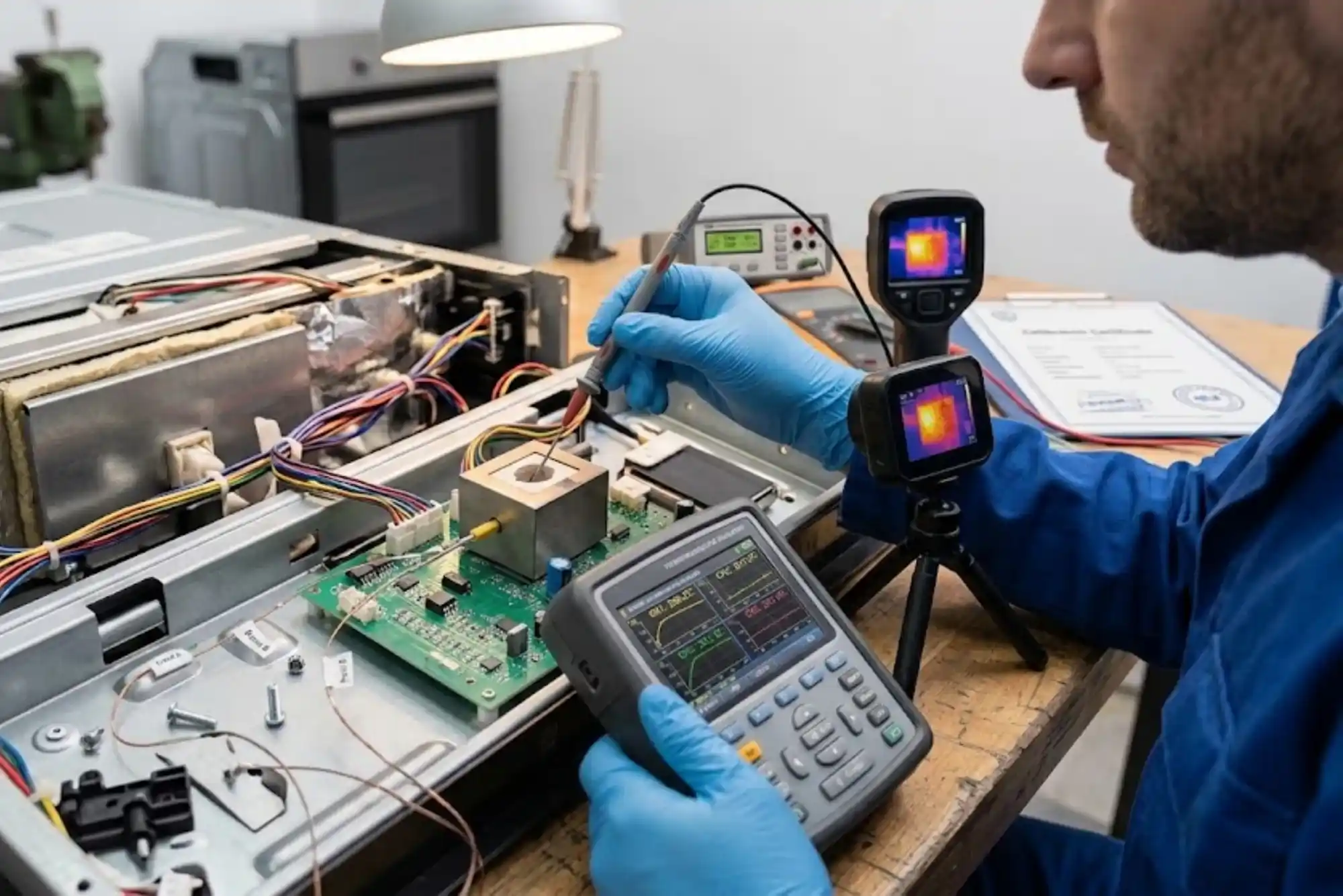
Oven Temperature Accuracy Testing involves comparing the oven’s indicated setting with readings obtained using a suitable temperature-measuring instrument.
The measurement instrument should be appropriate for the temperature range and testing environment. Its calibration status and measurement uncertainty should also be considered when accurate results are important.
A single temperature reading may not represent the complete operating behaviour of an oven. Temperature readings should be collected under suitable conditions and over an appropriate operating period.
The technician may also assess whether the oven maintains reasonably consistent performance after reaching its operating temperature.
Identifying the Temperature Difference
Once measurements are collected, the technician evaluates the difference between the selected temperature and the observed operating temperature.
The results must be interpreted according to the appliance’s specifications, the measurement method, and the expected temperature variation.
A deviation does not automatically prove that an electronic component is defective. Normal heating cycles, sensor position, airflow, and measurement uncertainty can influence the readings.
Adjustment or Component Repair
If the oven supports temperature adjustment and the results justify it, the technician may apply the manufacturer’s permitted correction.
If the problem originates from a defective thermostat, sensor, heating element, or electronic control system, the relevant repair should be completed first.
Professional Oven Temperature Testing should then be repeated to determine whether the appliance’s performance has improved.
Final Performance Verification
After the adjustment or repair, the technician checks the oven’s temperature behaviour again.
The customer can request a record of the testing conditions, observed readings, adjustment made, and any remaining limitations.
For applications requiring formal measurement traceability, the provider should explain the reference instrument, calibration documentation, and measurement uncertainty. NIST explains that metrological traceability requires a documented, unbroken chain of calibrations, with each step contributing to measurement uncertainty.
Domestic, Built-In, and Commercial Oven Calibration in Dubai
Different oven installations have different operating requirements, access arrangements, and testing considerations.
Domestic Oven Calibration
Domestic Oven Calibration is intended for household appliances used for everyday cooking and baking.
The inspection may cover temperature accuracy, thermostat response, sensor operation, heating elements, and electronic controls.
Homeowners should provide the oven’s model number and explain any recurring cooking problems. This helps the technician identify the appropriate manufacturer-specific testing procedure.
Built-In Oven Calibration
Built-In Oven Calibration requires consideration of the appliance’s installation arrangement.
The technician may need to assess access to electrical connections, ventilation conditions, installation clearances, and the oven’s control system.
A built-in oven should not be pulled out or dismantled by an unqualified person. Electrical isolation and manufacturer installation instructions must be followed during servicing.
Commercial Oven Calibration
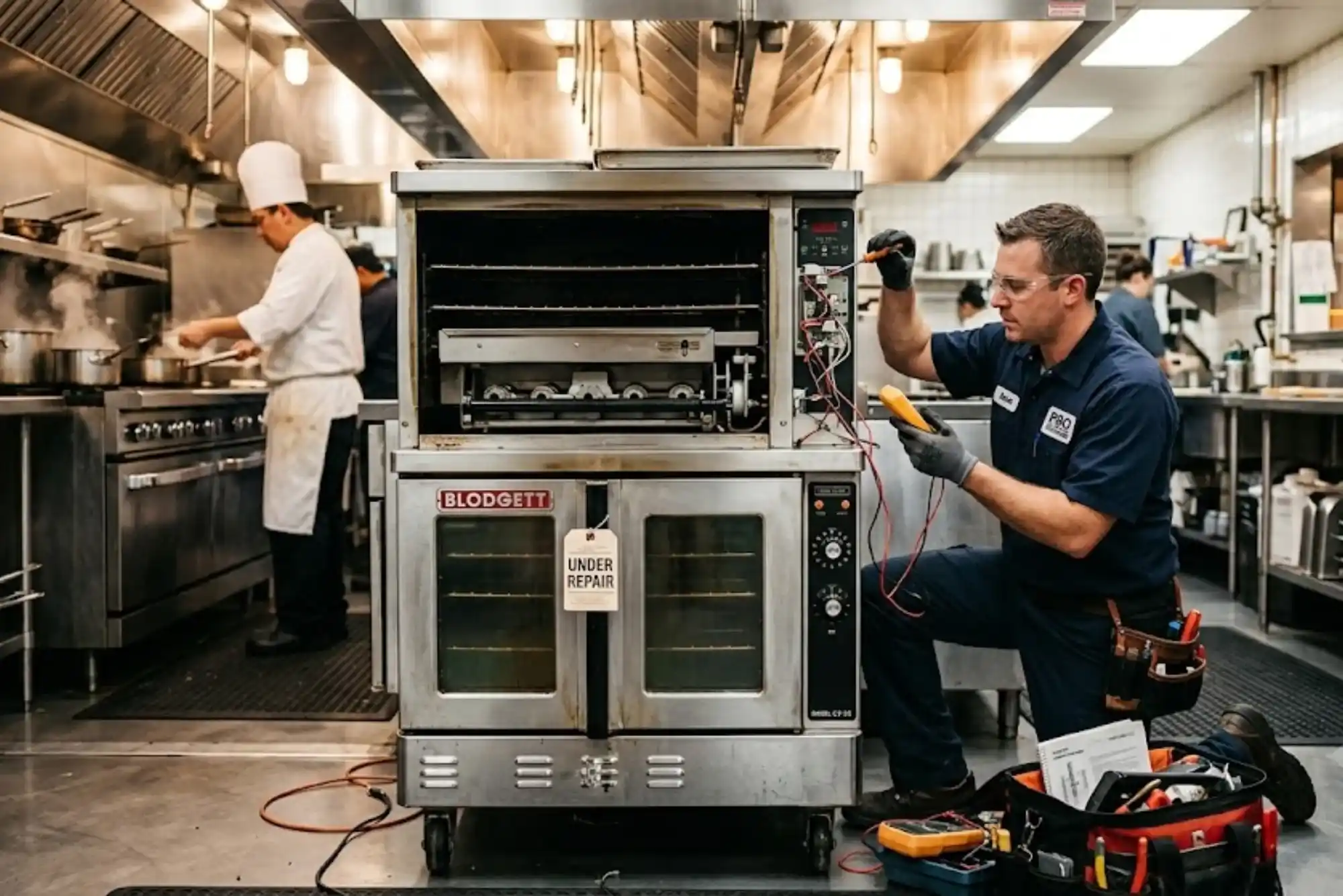
Commercial Oven Calibration is relevant to restaurants, catering facilities, hotels, bakeries, and other food preparation environments.
These appliances may have different capacities, heating arrangements, operating schedules, and temperature requirements.
Commercial kitchens should establish suitable temperature verification procedures based on their cooking processes and equipment specifications. Where measurement records are required for operational or quality-control purposes, the documentation should clearly identify the instrument, test conditions, measured results, and applicable acceptance criteria.
Businesses should also distinguish oven cavity calibration from food temperature monitoring. They measure different things and serve different purposes.
Important Factors to Consider Before Booking Oven Calibration in Dubai
Choosing an appropriate Electric Oven Calibration Service involves more than requesting a temperature adjustment.
Oven brand and model: Different manufacturers use different control systems, sensors, and adjustment procedures. The technician should identify the exact model before beginning work.
Testing equipment: Ask what temperature-measuring instrument will be used and whether its accuracy is suitable for the intended testing.
Manufacturer specifications: Temperature tolerance and adjustment options should be checked against the relevant appliance documentation.
Repair requirements: If the oven has a defective heating element or sensor, the problem may require repair before calibration can be completed.
Installation conditions: Ventilation, electrical connections, door sealing, and oven placement can affect operating performance.
Documentation: For commercial applications, ask whether the provider can supply a service report showing the testing conditions and results.
These considerations are particularly useful when comparing Professional Oven Calibration providers in Dubai.
Benefits and Limitations of Professional Oven Calibration
Professional calibration can improve temperature control when an oven has a correctable temperature deviation. However, it is important to understand what the service can and cannot achieve.
Benefits of Oven Calibration
More consistent cooking: Correcting an identified temperature deviation can help an oven produce more predictable cooking results.
Improved temperature control: Testing the sensor, thermostat, and electronic controls can help identify problems affecting temperature regulation.
Better appliance assessment: Calibration testing can reveal whether the problem involves an incorrect setting, a defective component, or another operating condition.
Support for commercial operations: Documented temperature checks can help commercial kitchens monitor equipment performance and maintain their own quality-control procedures.
Reduced unnecessary repairs: Proper diagnosis helps prevent replacement of components that are functioning correctly.
Limitations to Understand
Oven calibration cannot repair every heating or cooking problem. A damaged heating element, defective fan, poor door seal, or electrical fault may require separate maintenance.
Calibration also does not guarantee identical temperatures at every point inside the cooking cavity. Air circulation, food placement, cookware, and heating cycles can create temperature differences.
A calibration adjustment should never be used to conceal an underlying mechanical or electrical fault.
Common Oven Calibration Mistakes to Avoid
Incorrect calibration practices can make an oven less accurate instead of improving its performance.
Adjusting the Temperature Without Testing
Changing the temperature offset simply because food appears undercooked or overcooked can introduce additional inaccuracies.
The actual operating temperature should be measured before adjustments are made.
Relying on One Temperature Reading
A single reading may not reflect how an oven behaves throughout a complete heating cycle.
Testing should consider temperature changes over time and follow an appropriate measurement procedure.
Ignoring Heating Element Problems
A defective heating element cannot be corrected through thermostat adjustment alone.
If the oven struggles to reach the selected temperature, the heating system should be inspected before calibration settings are changed.
Using Unsuitable Temperature Instruments
A household thermometer may not provide the accuracy, temperature range, or measurement documentation required for a particular calibration task.
The measuring instrument should be suitable for the oven’s operating conditions and the accuracy required.
Making Unauthorised Electronic Adjustments
Changing internal settings, modifying control boards, or altering sensor connections without technical knowledge can create safety risks.
Always follow manufacturer instructions and use a qualified appliance technician for internal electrical work.
How to Choose an Oven Calibration and Maintenance Service
Selecting an appropriate service provider requires attention to technical capability, testing methods, and service transparency.
Before booking Oven Calibration And Maintenance, consider whether the provider can explain its diagnostic procedure and identify the equipment used for temperature measurement.
Ask whether the service includes temperature testing only or also covers thermostat adjustment, sensor inspection, heating-system checks, and necessary repairs.
For commercial applications, clarify whether a written report is available and whether the measurements meet the requirements of your specific quality-control process.
If your oven requires more than calibration, it is important to select a provider capable of diagnosing the related appliance fault.
For businesses operating restaurants and food preparation facilities, Al Barouda also provides information about its Oven Repair for Commercial Kitchens Dubai service. This is relevant when a commercial oven has heating, temperature-control, or other operational problems requiring repair rather than a simple adjustment.
Understanding Oven Calibration Costs in Dubai
The cost of Oven Calibration Services depends on the appliance type, testing requirements, and any additional repair work.
A domestic electric oven may require a straightforward temperature assessment, while a commercial appliance may need more extensive testing and documentation.
The quotation may also depend on whether the technician needs to adjust electronic settings, replace a temperature sensor, repair a thermostat, or inspect the heating system.
| Service requirement | Factors affecting the cost |
|---|---|
| Domestic oven calibration | Oven model and testing requirements |
| Digital oven calibration | Electronic controls and adjustment options |
| Thermostat calibration | Thermostat condition and repair requirements |
| Sensor testing | Sensor access and replacement requirements |
| Commercial oven calibration | Equipment type and documentation requirements |
| Calibration with repairs | Parts, labour, and additional diagnostics |
Specific Al Barouda calibration prices are not publicly specified in this article. Customers should contact the provider directly for a quotation based on the oven model and required service.
Before approving the work, ask whether the quotation includes inspection, temperature measurement, adjustment, replacement parts, and final verification. This helps establish exactly what the service covers.
Practical Oven Temperature Maintenance for Dubai Homes and Businesses
Regular appliance care can help maintain suitable oven operating conditions and make temperature-related problems easier to identify.
Follow the manufacturer’s cleaning instructions and keep the oven interior free from excessive grease and food residue. Avoid allowing water or cleaning chemicals to enter electronic controls, sensors, or electrical compartments.
Check the door seal for visible damage and ensure that the door closes properly. A damaged seal can affect heat retention and cooking performance.
Avoid blocking ventilation openings or installing the oven outside the manufacturer’s specified requirements.
Pay attention to recurring temperature problems, unusual heating behaviour, and persistent error messages. Arrange a professional inspection when these issues occur rather than repeatedly changing the temperature settings.
For commercial kitchens, maintain suitable equipment inspection and temperature-monitoring records according to operational needs and applicable food safety procedures.
Final Thoughts on Oven Calibration Services
Accurate oven temperature control supports consistent cooking performance in residential kitchens and commercial food preparation environments. When an oven repeatedly produces unexpected results, professional testing can help establish whether the cause is temperature deviation, a faulty sensor, thermostat problems, heating element damage, or another appliance issue.
Oven Calibration Services should involve suitable temperature measurement, comparison with manufacturer specifications, appropriate adjustment where possible, and final performance verification.
For homeowners and businesses in Dubai, choosing a service provider that explains its testing methods, repair requirements, and results can make the process more transparent.
Whether you need Domestic Oven Calibration, Built-In Oven Calibration, or Commercial Oven Calibration, the first step is to establish the actual condition of the appliance before changing its settings or replacing components.
1. What are Oven Calibration Services?
Oven Calibration Services involve measuring an oven’s actual operating temperature, comparing it with its selected setting and manufacturer specifications, and determining whether an adjustment or repair is necessary.
2. How do I know if my oven needs temperature calibration?
Repeatedly undercooked or overcooked food, inconsistent cooking results, and unusual temperature behaviour may indicate a calibration issue. Temperature testing is needed to confirm the cause.
3. How often should an oven be calibrated?
There is no universal calibration interval for every oven. The appropriate frequency depends on manufacturer recommendations, appliance usage, operating conditions, and the accuracy requirements of the user.
4. Can I calibrate my electric oven myself?
Some ovens provide a manufacturer-approved temperature offset setting that users can adjust through the control panel. Internal thermostat, sensor, and electrical repairs should be handled by a qualified technician.
5. What is the difference between oven calibration and thermostat repair?
Calibration checks temperature accuracy and determines whether an adjustment is required. Thermostat repair addresses a defective temperature-control component. A faulty thermostat may need repair or replacement before accurate calibration is possible.
6. How much do oven calibration services cost in Dubai?
Costs depend on the oven model, testing requirements, and whether additional repairs or replacement components are necessary. Contact the service provider for an appliance-specific quotation.
Related Reading: Siemens Refrigerator Error Code