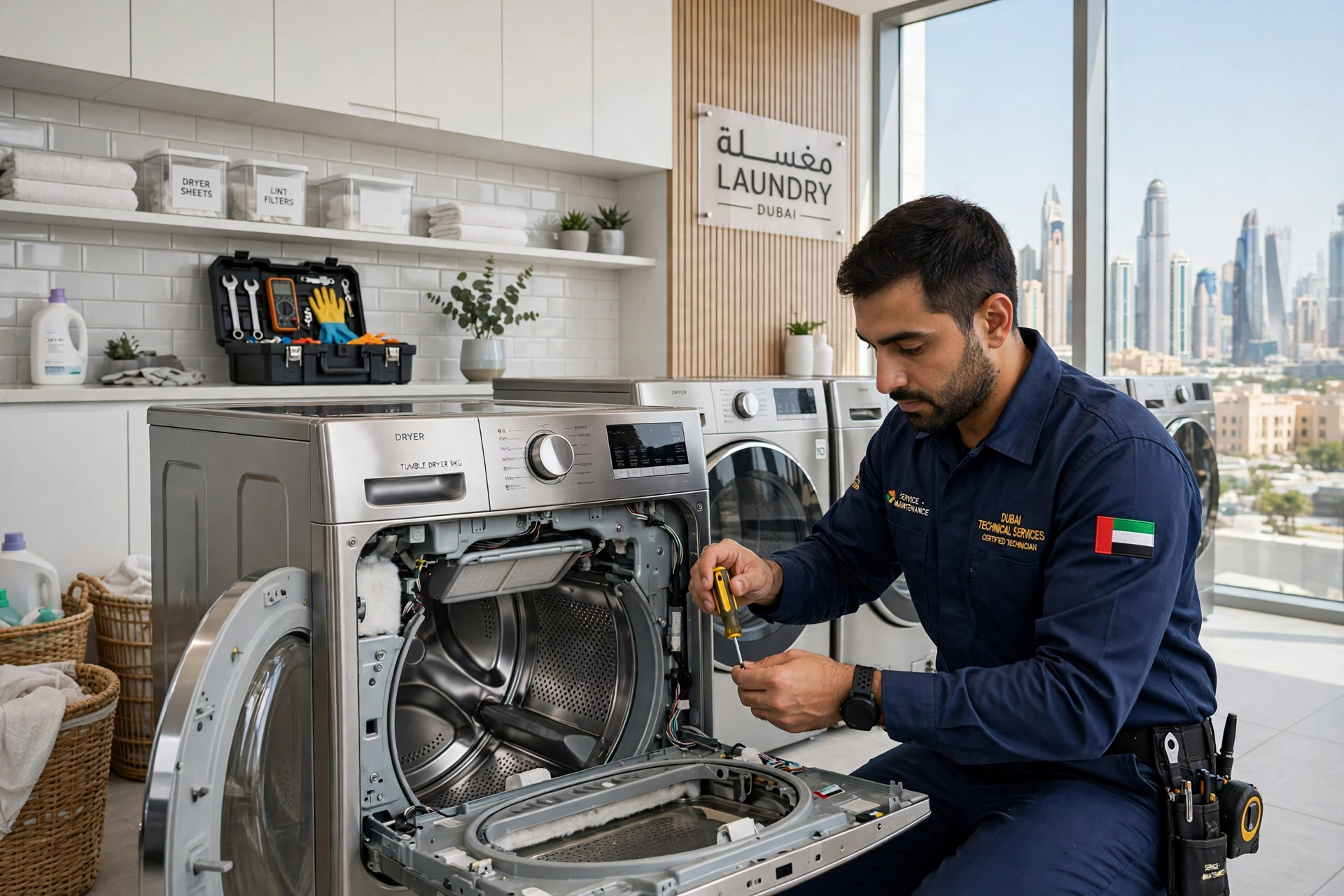
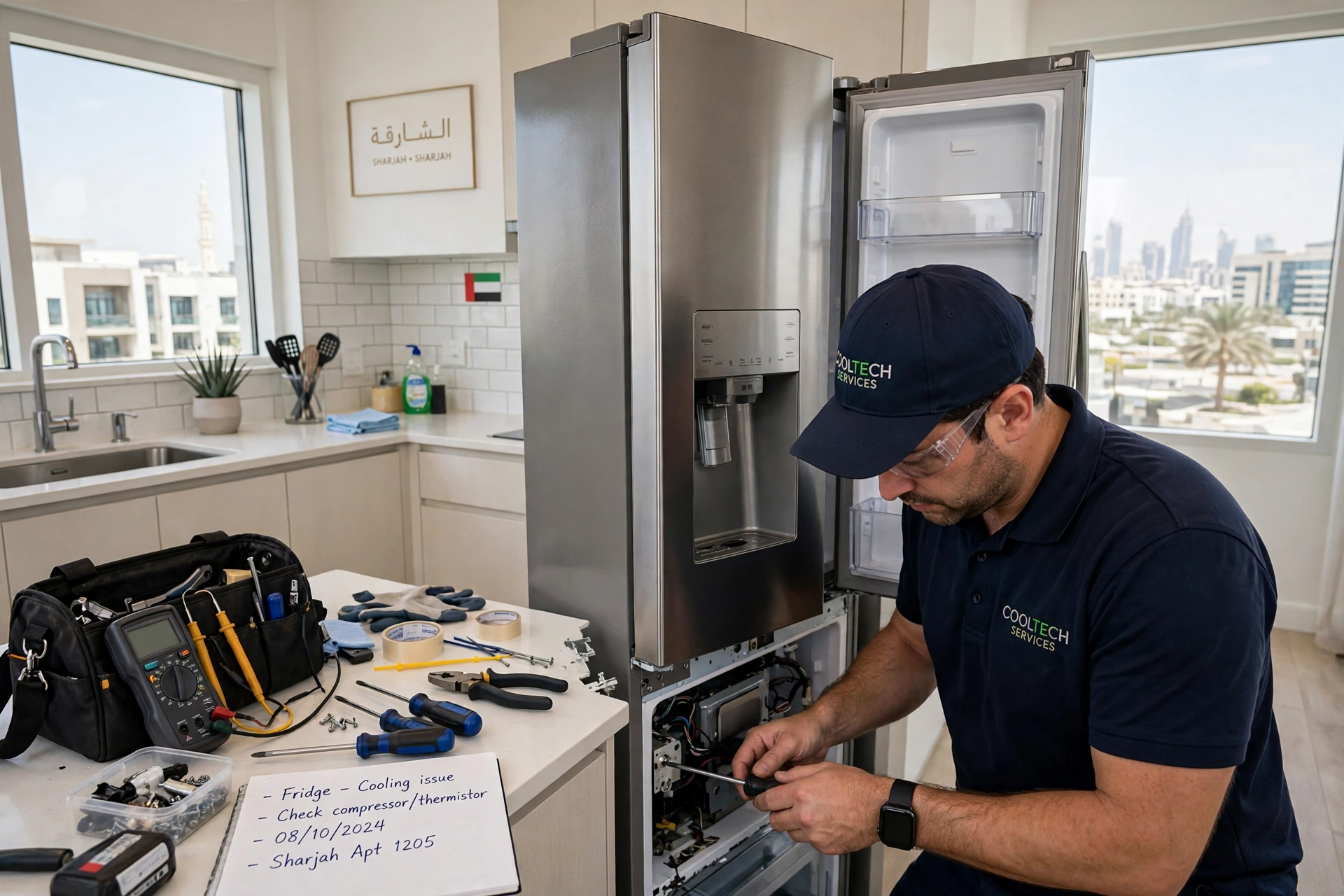
There is a particular kind of panic that sets in when the dryer dies on a school night in Sharjah. The washing machine has done its part, the laundry basket is full, and the uniforms and work shirts that need to be ready by morning are sitting damp in the drum. Outside, the air hangs heavy with humidity — exactly the conditions in which line-drying takes forever and leaves fabrics smelling musty.
It is a scene familiar to thousands of households across the emirate, from the towers of Al Nahda to the villas of Muwaileh. The tumble dryer is one of the hardest-working appliances in a UAE home, and when it breaks down, daily routines stall. This guide covers the faults local technicians see most often, why the climate here punishes dryers, how to decide between repair and replacement, and the maintenance habits that keep a machine running for years.
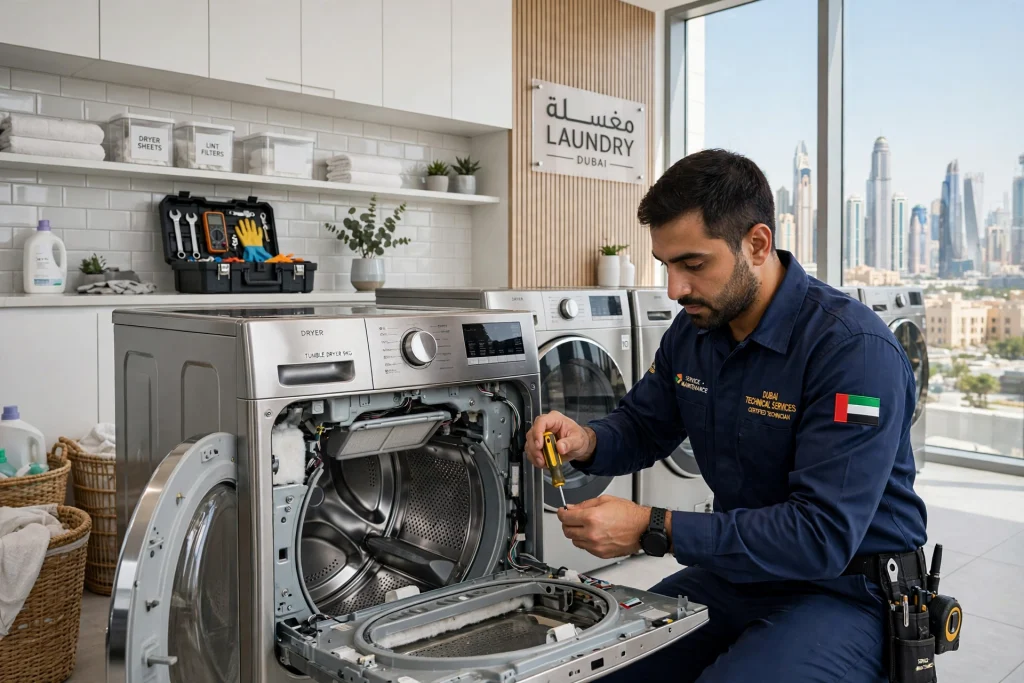
Why Sharjah is unusually tough on tumble dryers
The Emirates ask more of a clothes dryer than most climates do. Humid summers demand longer cycles, and many households run the machine almost daily — a far heavier workload than the occasional use typical in cooler countries. Fine dust infiltrates filters and venting, and when lint compacts inside a hot duct, airflow suffers and components overheat.
Installation matters too. In many apartments the machine sits on a service balcony or in a tight laundry corner with barely enough clearance for ventilation. A dryer that cannot breathe works harder on every load, and the strain shows first in the heating element, the drive belt and the motor.
The faults technicians see most often in Sharjah homes
Most dryer breakdowns fall into a handful of familiar patterns. Knowing which one you are facing helps you describe it accurately when you call for help — and tells you whether it is safe to keep using the machine meanwhile.
The dryer runs but produces no heat
This is the most common complaint: the drum turns but clothes come out damp. The usual suspects are a failed heating element, a blown thermal fuse or a faulty thermostat. Fuses often blow because of restricted airflow, so a good technician checks the venting too — replacing the fuse without clearing the blockage leads to a repeat failure.

The drum will not turn
When the motor hums but the drum stays still, the drive belt has usually snapped or slipped off — a straightforward fix. Occasionally the cause is a seized drum roller or a failed motor capacitor, which is why proper diagnosis beats ordering parts on guesswork.
Clothes take far too long to dry
If drying times have crept up gradually, suspect airflow: a clogged lint filter, a kinked vent hose, or an outlet blocked by dust. The machine compensates by running longer, so electricity consumption climbs too — another reason not to ignore it.
Unusual noises: thumping, squealing or grinding
A rhythmic thump often means worn drum rollers; a high-pitched squeal points to the idler pulley or belt; grinding can indicate bearing or motor trouble. Noises rarely resolve themselves, and running the machine regardless can turn a modest repair into a major one.
The dryer will not start, or stops mid-cycle
A completely dead machine may just have a tripped breaker or a faulty door switch — dryers will not run with the door circuit open. Stopping mid-cycle usually means overheating: blocked vents trip the thermal cut-out, and the machine shuts down to protect the motor.
A burning smell or an unusually hot cabinet
Take this seriously. Stop the machine, switch it off at the socket, and do not use it again until it has been inspected. Burning smells usually mean lint near the heating element or overheating wiring — both genuine fire risks.
Repair or replace? How to make the call
A rule of thumb used across the appliance trade: if the repair would cost more than half the price of a comparable new machine and the dryer is past eight years old, replacement is usually the wiser investment. A younger machine with a single failed part — a belt, a thermostat, a door switch — is almost always worth fixing.
Energy efficiency is the other half of the equation. Dryer technology has moved on, and independent guidance from ENERGY STAR explains how sensor drying and heat-pump designs cut running costs. If your machine is an ageing energy-guzzler and the repair bill is substantial, upgrading can pay for itself through lower utility bills.
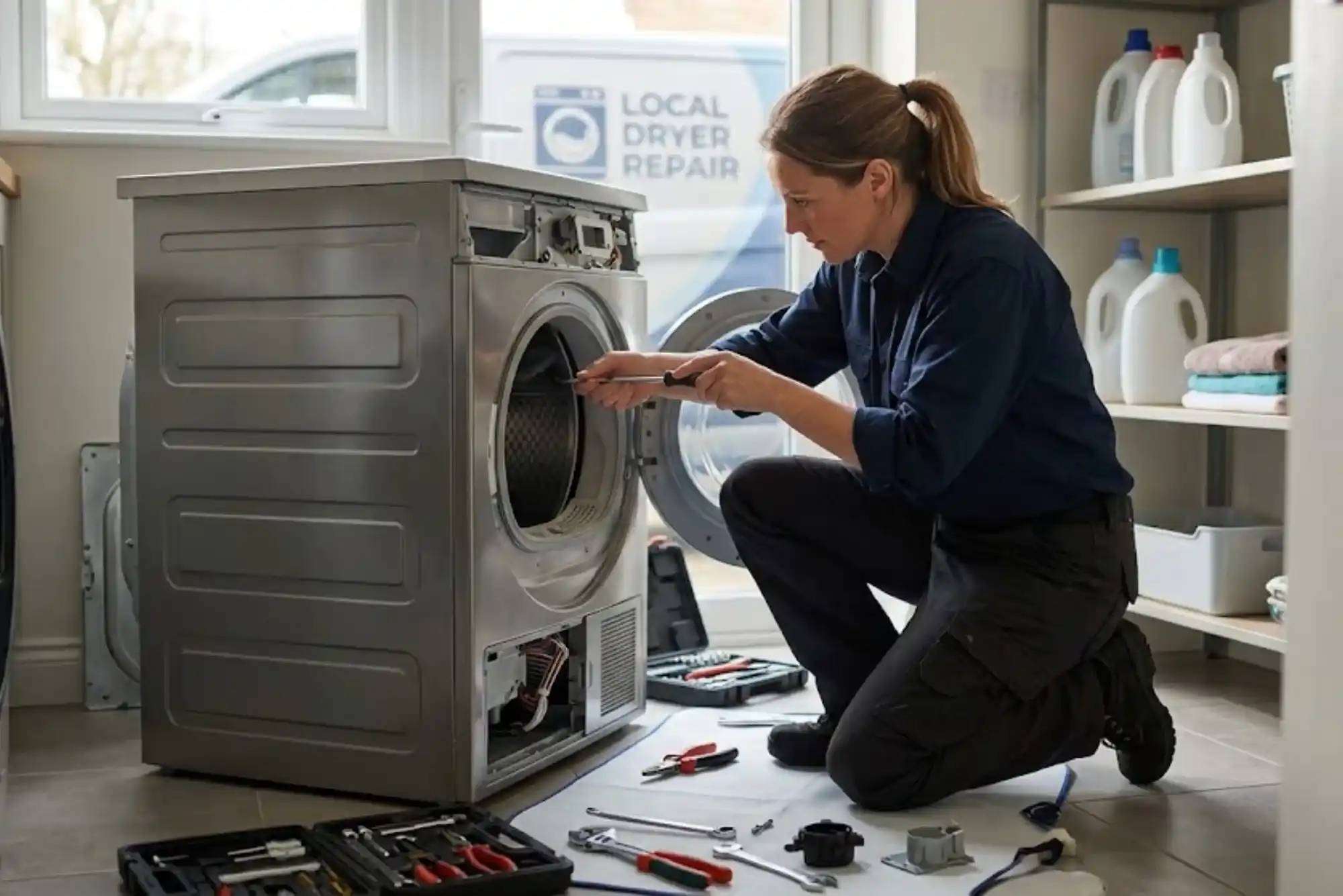
What happens during a professional dryer repair visit
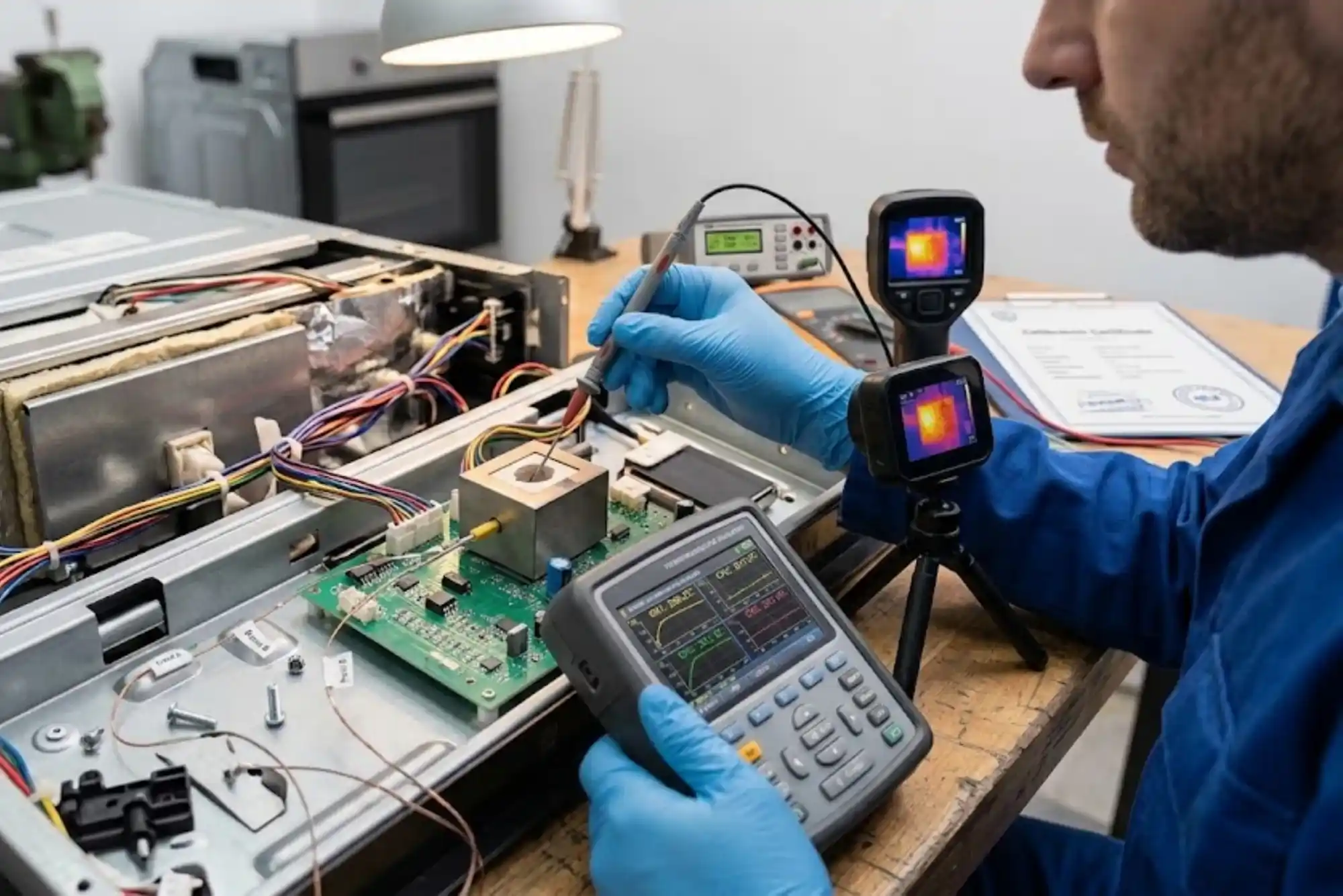
A proper service call follows a set sequence. The technician listens to your description, then runs the machine while checking airflow, heat output and drum movement. Electrical parts — element, thermostats, fuses, motor windings — are tested with a multimeter rather than replaced speculatively, keeping the bill to what is genuinely needed.
You should be told what the repair involves and what it costs before any work begins. Established appliance repair services in the Emirates handle all major brands — Samsung, LG, Bosch, Siemens, Whirlpool and Miele — and after the repair the machine is run through a full test cycle. Most common faults are resolved in a single visit.
What does dryer repair cost in Sharjah?
Prices vary by fault and brand, so treat these as typical market ranges, not quotes: a diagnostic visit commonly falls between AED 100 and AED 150; straightforward repairs such as belts, thermostats or door switches often land between AED 150 and AED 300 including parts; bigger jobs — motors, control boards, drum rebuilds — can run from AED 350 to AED 600 or more for premium brands. Reputable firms give a free quote before starting.
Maintenance habits that prevent most breakdowns
Most dryer failures are preventable. These five habits make an outsized difference:
- Clean the lint filter after every load — ten seconds of effort, and the best thing you can do for airflow, drying times and safety.
- Inspect the vent hose and outside outlet every few months; straighten kinks and clear dust from the outlet.
- Do not overload. A packed drum cannot tumble freely, so hot air never reaches the middle — drying takes longer and the motor strains.
- Wipe the moisture sensor occasionally; softener-sheet residue can coat the sensor bars and confuse cycle timing.
- Book a yearly professional service: a technician checks belt tension, clears hidden lint build-up and spots worn rollers before they fail.
The safety angle: lint, heat and common sense
A dryer deliberately exposes fabric to heat, so lint management is a safety issue as well as a performance one. Safety guidance recommends cleaning the lint filter after every cycle and keeping the duct clear — see the dryer safety overview on Wikipedia. Never run a dryer unattended, and never dry items contaminated with flammable substances like cooking oil.
Booking dryer repair in Sharjah: what to look for
Look for same-day appointments, round-the-clock availability and a free quote before work begins. Check the company handles your brand and serves your area — established firms cover Dubai, Sharjah and Ajman. Al Barouda’s dedicated dryer repair service covers diagnosis, vent cleaning and parts replacement across all three emirates: +971 58 293 5151 or fastrepaircaredubai@gmail.com. Fifteen-plus years in the trade shows in faster diagnoses and repairs that last. A quick search for dryer repair Sharjah returns plenty of options — use the checklist above to choose well.
A note for visitors and new residents
New to the Emirates, or just visiting? Household logistics are only one small part of settling in. For practical guidance on visas, neighbourhoods and getting around, the UAE travel guides at UAE Travel Brief are a genuinely useful starting point.
Frequently asked questions
How quickly can I get my dryer repaired in Sharjah?
Most established companies offer same-day service within Sharjah, with 24/7 booking lines — an urgent breakdown rarely waits until the next working day.
Is it worth repairing a dryer over ten years old?
Sometimes. A minor fix on a sound machine can still pay off, but if the quote tops half the price of a new dryer, replacement usually wins — especially given modern efficiency gains.
Why does my dryer need two cycles per load?
Almost always restricted airflow: full lint filter, blocked vent hose or dusty outlet. Clean all three; if it persists, the heating element or thermostat needs a professional.