Anyone who has moved into a new flat in Dubai knows the first week is a crash course in how the place actually works — the AC settings, the water pressure, the quirks of a kitchen you did not design. It is why so many newcomers start with the practical living guides on UAE Travel Brief first.
The cooker hood is one of those surprises. It hangs quietly above the hob for months until one evening the kitchen fills with smoke and the hood just hums along, pulling nothing. In Dubai’s open-plan kitchens, a failing extractor means smoke on the sofa and a smell that lingers long after dinner. The good news: most cooker hood problems are straightforward, and almost all are repairable in a single visit, for far less than a replacement hood.
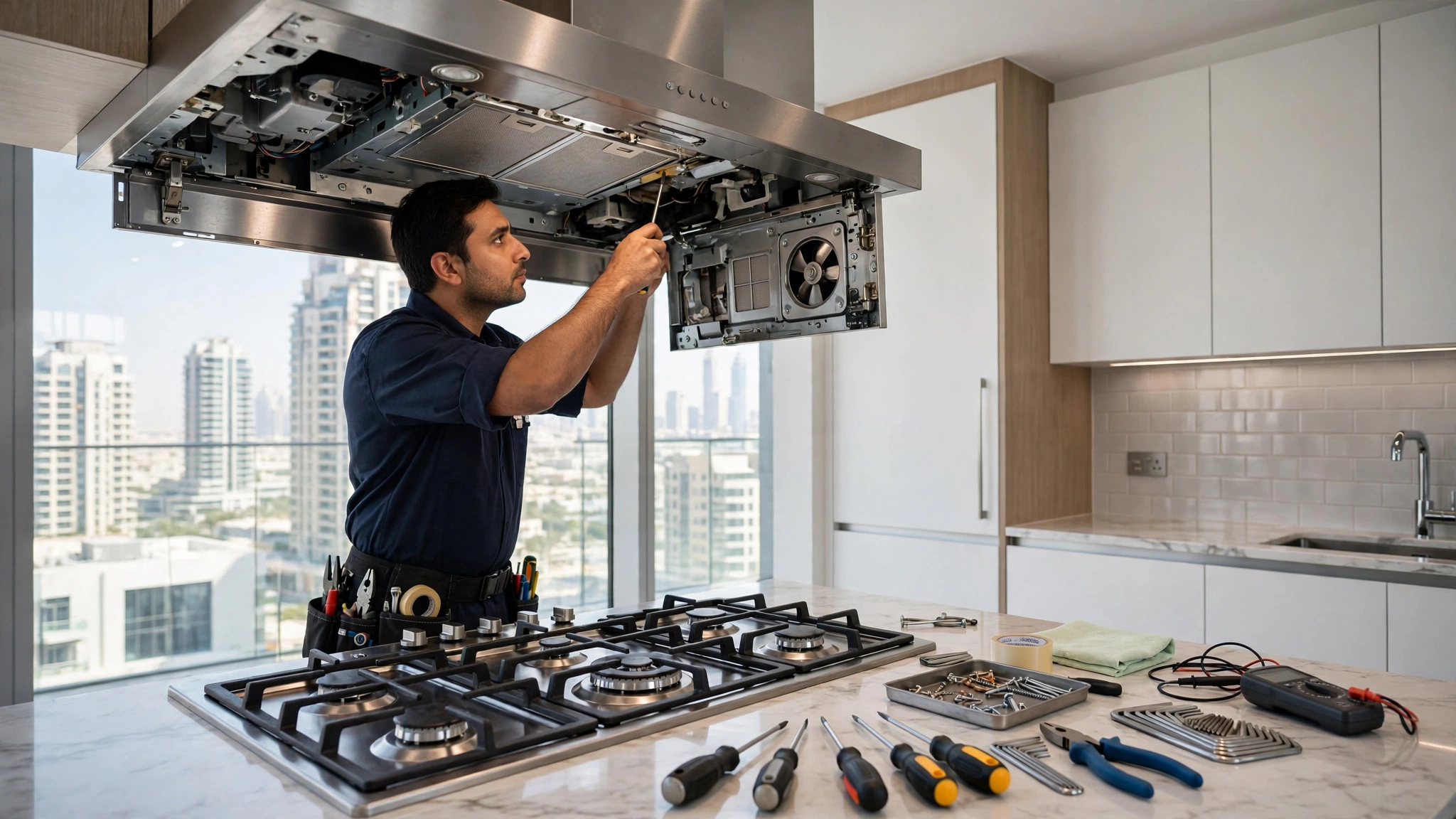
The signs your cooker hood needs attention
A healthy hood pulls steam and smoke up and out, traps grease before it reaches the duct, and does both quietly. When any of those slips, the hood is telling you something.
Weak suction is the most common complaint. Hold kitchen tissue against the filter while the hood runs on its highest speed — if the paper barely moves, the hood is not extracting properly, even if the fan sounds normal. Another tell-tale sign is condensation: if mirrors fog and cabinets feel damp after cooking, steam is drifting sideways instead of rising into the hood.
Noise is the second sign: a low hum is normal; a rattle, grinding or whine is not. Rattles often mean a loose filter or panel, or a fan blade touching its housing. Grinding usually points to worn motor bearings, and a whine that rises with fan speed can mean the motor straining against a blocked duct. Then there are smells: if last night’s frying still hangs in the air this morning, the hood is recirculating greasy air instead of removing it.
Why suction fades: the usual suspects
Weak suction usually comes down to one of four causes, the first and simplest: the grease filter is clogged. Dubai cooking — frying, searing, tempering spices in hot oil — throws far more grease into the air than a European kitchen manual imagines. That grease collects in the metal mesh filter, and as the mesh clogs, air cannot pass. Suction falls away gradually, so you may not notice for months, until the hood seems to have stopped working entirely — when it is just suffocating behind a filter that has never been cleaned.
The second cause is the duct. Ducted hoods push air outside through a pipe in the wall or ceiling, and over years grease builds up inside it, narrowing it. In some apartments the duct run is long, with bends that trap grease; in others, an outside vent flap has stuck shut. A technician can check airflow at the outlet and tell in minutes whether the duct is the problem.
The third cause is the motor. Hood motors are built for years of service, but they wear out — especially where the hood runs for hours daily. A tired motor spins slower, pulls less air, and runs hotter and louder. Capacitor failure is another common fault — the fan hums but barely turns — and it is a cheap part to replace.
The fourth cause is installation. A hood mounted too high above the hob cannot capture rising steam, however strong its motor — the usual guidance is 65 to 75 centimetres above an electric hob, slightly more above gas. A hood narrower than the hob will miss smoke from the outer burners.
Noise, smells and lights: what each symptom means
A rattle that starts suddenly is often simple: a filter that has not clicked back into place after cleaning, or a loose screw on the chimney cover. Switch the hood off, remove the filters, refit them firmly, and check the cover screws — if the rattle stops, you have fixed it for free. A rattle that persists usually lives deeper — a fan blade loose on its spindle, or a motor mount that has perished — and that needs the hood opened up, so this is technician territory.
Grinding or screeching is almost always the motor bearings, which cannot be oiled back to health once worn. Smells that linger after cooking usually mean the carbon filter has expired — in recirculating hoods, common in apartments without an outside duct, carbon filters saturate and most manufacturers suggest replacing them every three to six months in a busy kitchen. Lights run on a separate circuit from the fan, so dead lights with a working fan mean an electrical fault — a blown bulb, a tired transformer or a failing switch.
What a technician actually checks
When an Al Barouda technician arrives, the visit follows a set sequence. First the airflow test — tissue against the filter, then a check of the outside vent if the hood is ducted — and the filters come out: a mesh filter caked in grease explains most weak-suction calls on the spot. Next the motor and capacitor: the technician listens to the motor under load, checks whether the fan spins freely, and tests the capacitor with a meter. A motor that hums without turning is usually a capacitor; one that turns slowly and noisily is usually bearings. Then the duct, vent and wiring are checked — loose connections are common in kitchens, where heat and vibration loosen terminals over the years.
Only after that diagnosis does the technician quote. That order matters: you get an honest price before anyone picks up a screwdriver, and the quote is free — no visit fee, whatever you decide.
Cleaning the filters yourself — safely
Metal mesh filters are the one part of a cooker hood you can and should maintain yourself. Take them out — most slide or hinge out without tools — and soak them in hot water with dishwashing liquid. After twenty minutes, scrub gently with a soft brush, rinse, and let them dry completely before refitting; a filter put back wet can drip greasy water into the motor housing. Do this monthly where you cook daily, every two months if you cook lightly. Before you buy parts, manufacturer guidance is worth reading — Bosch’s UAE site covers cooker hood maintenance, and the principles apply to most brands.
Do not open the motor housing, touch the capacitor, or work on the wiring — capacitors can hold a charge even with the power off. Leave those to a technician.
What does cooker hood repair cost in Dubai?
This is the question every caller asks, and the honest answer is that it depends on the fault: a filter clean or a capacitor replacement is a small job, a motor replacement a bigger one, and part prices vary by brand and model. What we can promise is the process, because it never changes: call +971 58 293 5151, describe the symptoms, and we will give you an honest price before any work starts. The quote is free, there is no visit fee, and the technician arrives in the agreed time slot.
When to call a professional
Call a technician when the fan hums but does not spin, when the motor grinds or screeches, when the hood trips the breaker, when there is any burning smell, or when suction is still weak after cleaning the filters. All get worse — and more expensive — if left running. If your oven is also playing up, our oven repair in Sharjah guide covers the faults we see most there; the microwave repair guide and the dishwasher repair guide cover the other kitchen essentials, and for laundry, the washing machine repair guide follows the same approach.
Frequently asked questions
How often should I clean my cooker hood filter?
Monthly if you cook daily, especially if you fry often — a clogged filter is the most common cause.
Why does my cooker hood make a loud noise?
Usually a loose filter or panel, a fan blade touching its housing, or worn motor bearings. Grinding means bearings — call a technician.
My hood works but the kitchen still smells. Why?
In a recirculating hood, the carbon filter is almost certainly saturated — replace it every three to six months. In a ducted hood, check the vent flap opens and the duct is clear of grease.
Is it cheaper to repair or replace a cooker hood?
For most faults — filters, capacitors, switches, lights — repair is far cheaper than replacement. A motor replacement costs more, but usually less than a new hood plus installation. Get a free quote; there is no visit fee.
A cooker hood is a simple machine doing a hard job in a hot, greasy kitchen. Keep its filters clean, and call a technician the moment it starts struggling. If yours has stopped pulling its weight, call Al Barouda on +971 58 293 5151 — same-day service, no visit fee, free quote before any work begins.
Related Reading: Air Conditioner Maintenance and Repair Dubai
Related Reading: Dryer Repair Sharjah: Your Complete Guide to Fast, Reliable Fixes